In Cibitoke, we’re moving toward the final goal of our Water Source of Life and Development project: the construction of a 21-kilometer aqueduct that will provide drinking water to this part of Burundi, where it has never been available before. However, before reaching this stage, a complex restoration project had to be completed. ” We had to begin rehabilitation activities at the Nyaruseke spring,” explains Dimitri, coordinator for CASOBU, AMU’s local partner.
Rehabilitation of the Nyaruseke spring and restoration of hydraulic works
This preparatory work can now be considered complete. To date, 14 tanks of varying capacities and 19 public fountains have been restored.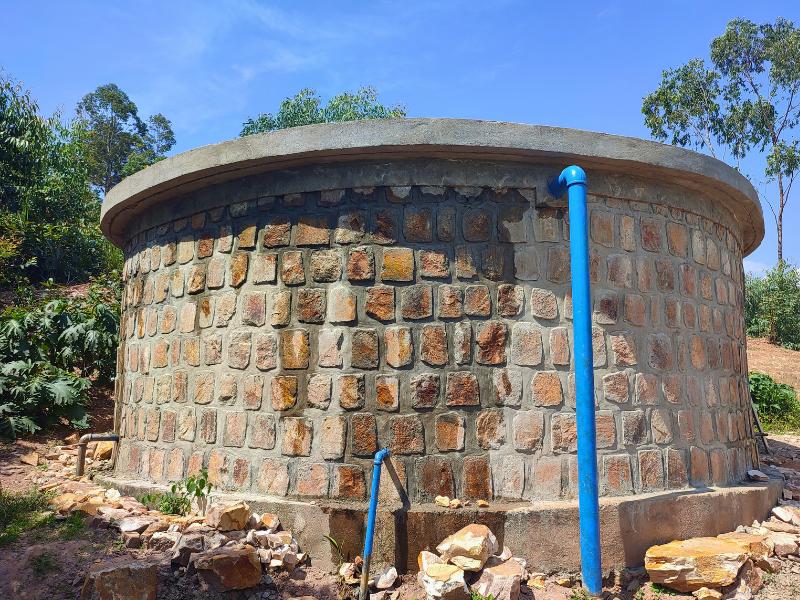 (And seeing the children wandering around is a great joy!). Furthermore, four passage structures and other key hydraulic works, such as the control rooms and sectioning rooms, have been rehabilitated.
These are structures located along the network in which the equipment necessary to manage the flow of water is installed and which serve to divide the network itself into independent sections to isolate faults or leaks.
Logistical and Technical Challenges: Alex’s Story
During the project’s implementation, there were numerous challenges. Alex, Dimitri’s assistant, explained: “The first was logistical: it takes an hour’s walk to reach the spring, and to transport the materials, the workers had to carry them on their heads and walk the entire way.”
A second difficulty emerged during the rehabilitation of the fountains: “Sometimes the pipes were so rusty that we had to demolish everything and rebuild from scratch. We also encountered problems with the tanks, especially in the drainpipes where pieces of wood were inserted to block or stop the water. It was extremely difficult to remove them, and we often had to demolish and rebuild the dividing walls to allow the water to flow smoothly.”
Optimizing your reach: Clustering sources for your community
The Nyaruseke spring has now been fully restored thanks to the work of workers and technicians from the communities who will benefit from the drinking water.
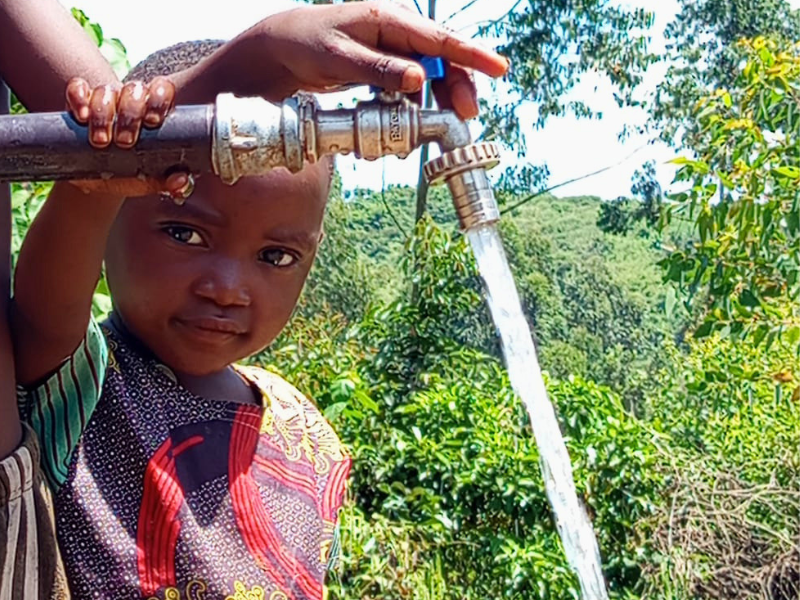 Dimitri explains the complexity of the operation: “This is made up of five different small springs, some of which were no longer functioning, so we had to group them all together to obtain a significant water flow.”
The project doesn’t stop there: “We’ve also rehabilitated the spring called Nyaruhanga, located a 45-minute walk away. It has a flow rate of about 2.5 liters per second, which we intend to add to the Nyaruseke spring to ensure the water capacity needed to serve the entire network.”