
While the final construction work on the new Rubirizi-Rukana aqueduct in Burundi continues, we turn our attention to the first phase of the Water: Source of Life and Development project, which saw the construction of ecological latrines in the province of Cibitoke where – together with our local partner CASOBU – we are building the drinking water pipelines ( click here to read all the updates ).
These are the 35 ecological latrines built in recent months thanks to funding from the Emilia Romagna and Friuli Venezia Giulia regions. The results reported to us are extraordinary, and go beyond anything previously expected: the integration of ecological latrines and sustainable agriculture is bringing tangible and visible benefits to the environment, health, and the local economy. This positive impact extends from household hygiene to the protection of groundwater.
All of this, moreover, has a profound impact on the local economy: the fertilizer, in addition to significantly increasing agricultural production, is resold, thus allowing communities access to a natural fertilizer instead of chemical fertilizers, which are much more expensive and harmful to the soil.
Ecological latrines and sustainable agriculture: concrete results on crop yields
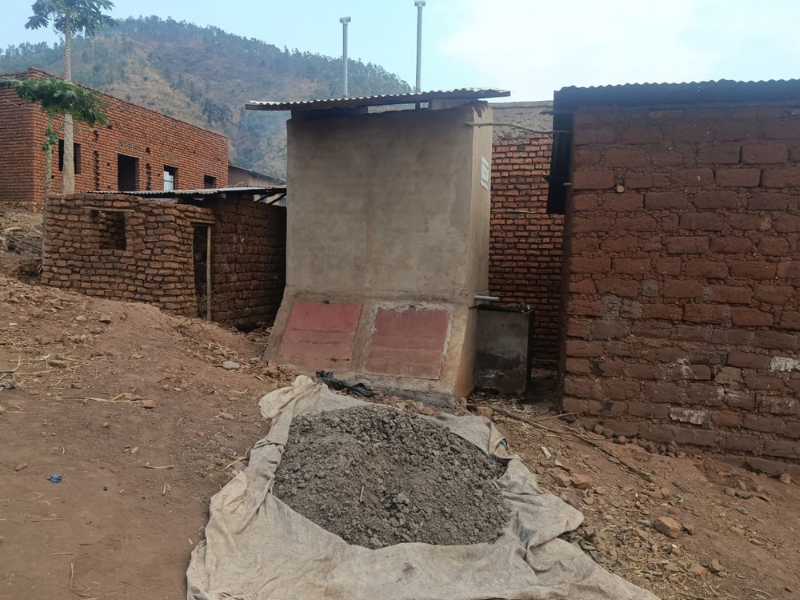 For families who are using the latrines correctly, the positive impact is immediate. Of the 35 latrines built, 30 are already in proper use, resulting in a significant improvement in sanitation and hygiene conditions and a significant decrease in cholera cases.
Furthermore, by March, a stock of 157 sanitized urine containers had been reached, ready to be used as natural fertilizer in the following agricultural season.
Transforming waste into organic fertilizer is resulting in incredibly thriving crops. Here are some extraordinary numbers.
The numbers of the crops
Cabbage crops: A field treated with organic latrine manure produced cabbages weighing a record 5 kg each (up from 1.5 kg previously), for a total production three times higher.
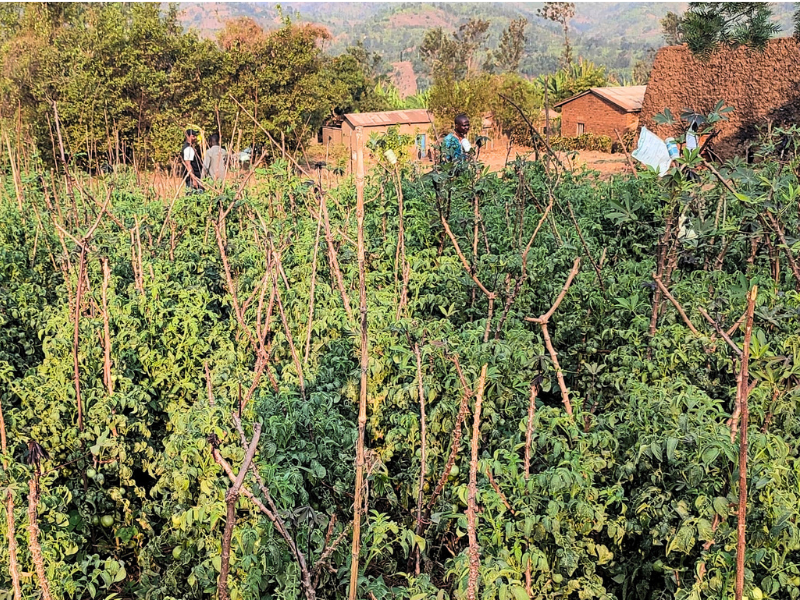 Amaranth cultivation: Fertilized fields have doubled the usual yield.
Tomato and sorghum cultivation: Field images show enthusiastic farmers. A sorghum field cultivated with an initial investment of 500,000 BIF (Burundian franc) generated revenues of 1,650,000 BIF, a significant economic turnaround. In this case, the farmers more than tripled their initial capital in a single harvest.
1,650,000 BIF is equivalent to approximately 333 euros. Considering that Burundi’s average per capita income is among the lowest in the world (often less than 1-2 euros a day), generating a net margin of over 300 euros represents extraordinary income.
Towards the next steps: completing the aqueduct works
Reaching a milestone like this is something exceptional, which makes all the protagonists of the project proud. Water, source of life and development.
Now the project moves toward the next major goal: completing the entire construction of the aqueduct, to bring clean, drinkable water to places where it has never been before.