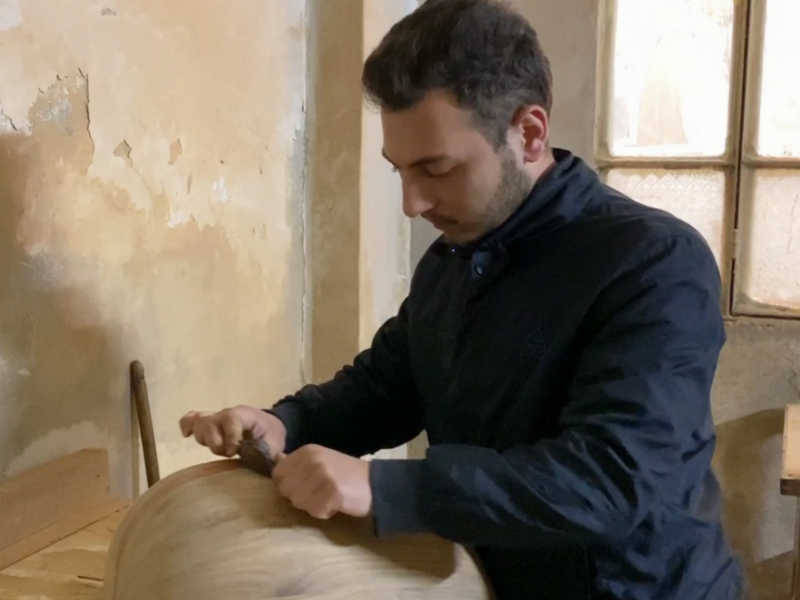
Working wood, cutting it, sanding it, and transforming it into a musical instrument takes talent. It’s a kind of magic, combining craft, tradition, history, music, and a great deal of passion. Not to mention patience, meticulousness, and a certain ability to see beyond the raw material in your hands and glimpse what it will become: in the case of young Melad, the final magic will take the form, and above all, the sound, of an oud.
What is oud ?
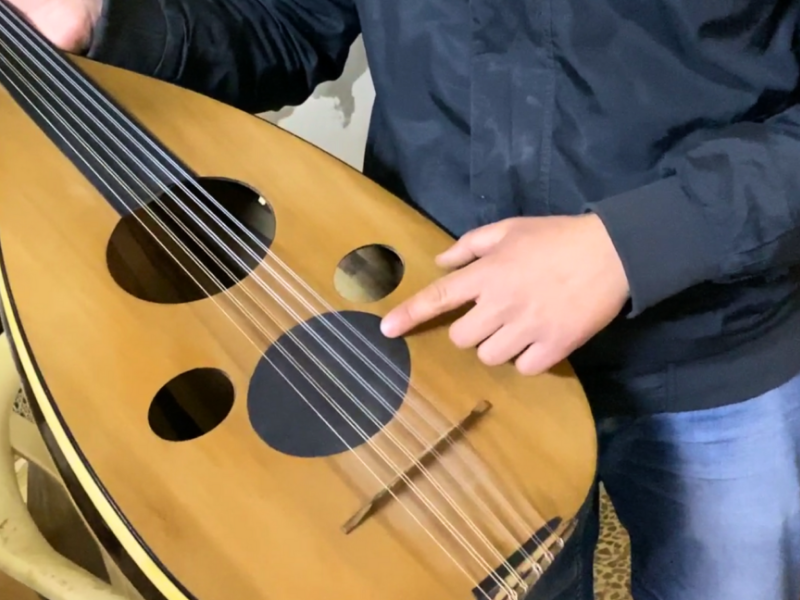 The oud is a stringed instrument belonging to the short-necked lute family and widely used in Middle Eastern and North African music. In Arabic, the word ūd means “wood.”
It’s considered one of the oldest instruments in human history. Melad started making ouds when he was in high school, and hasn’t stopped since.
Melad and the art of making oud
Melad is 26 years old and lives in Homs , Syria. He studies at the Conservatory and works in a musical craft workshop where he creates this ancient stringed instrument: “I had a passion for woodworking and I enjoyed making ouds because I can play them and I also wanted to study them.”
Thus, Melad’s two activities run parallel: he studies music and also learns to model his favorite instrument . However, he faces an obstacle: in the laboratory, he can only use the limited resources available. Wood, in particular, is never enough. How can he overcome this problem?
RestarT’s support
 “I needed support to purchase materials and wood, so when I heard about the RestarT project I applied.”
Melad finally finds a new path to take to get oud production off the ground by turning to the AMU project which provides support for small production activities in Syria, helping in a concrete way those who want to stay and live and work in the country.
These are micro-entrepreneurship projects, which are constantly supported by a local team that provides technical and psychosocial support.
Melad is provided with raw wood and suitable tools. He immediately realizes the benefits are significant: “My work has improved: before, I had to wait until I sold at least two ouds to get enough money to buy something for the workshop, but now I don’t. The business is doing so well that I’ve even managed to lower my prices, and as a result, I have more customers.”
Oud and reciprocity
When the project’s participants are admitted to RestarT, they commit to returning 50 percent of their donations in cash, and the remainder in the form of goods and services to the community, thus creating a virtuous circle of mutual aid and support.
Melad also generously contributes to strengthening this sense of solidarity: “I was able to teach the art of making the oud to a young man who wanted to, free of charge.”