In this second part of the mission, my primary task was to closely evaluate and monitor the rehabilitation and construction of the new aqueduct in Burundi . After discussing it remotely with my local counterpart, CASOBU, seeing the project finally take shape before my eyes is a thrill that makes all the hard work necessary to get this far worthwhile.
The long journey of the aqueduct pipes
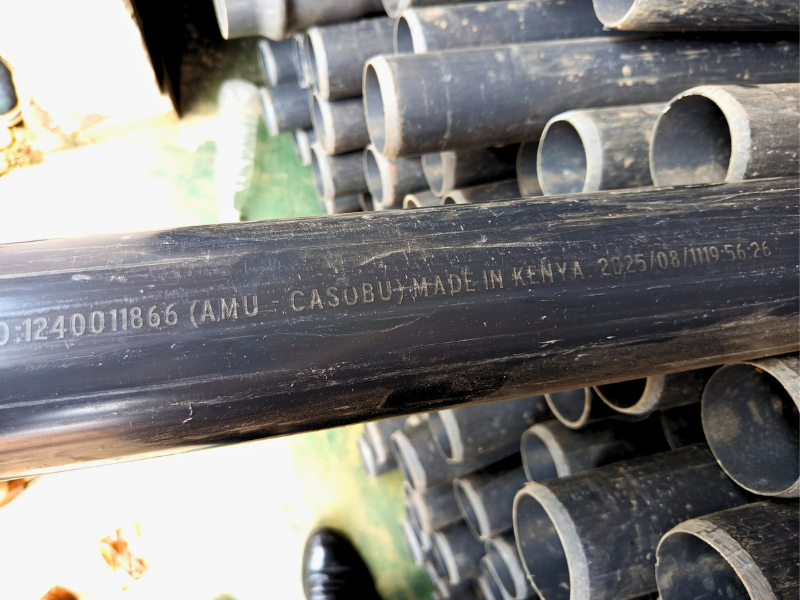 The pipes have been the focus of much attention in recent months due to delivery delays. For various logistical reasons, we couldn’t purchase them directly in Burundi, but had to have them shipped from Kenya through a series of significant detours and obstacles.
When I arrived, I found a large number of them, but only half of what was expected: the rest had already been transported to the field. Each one is stamped ” AMU and CASOBU, Made in Kenya” to prevent theft and highlight the project’s ownership. This engraving demonstrates how the history of this aqueduct in Burundi is deeply intertwined with our commitment.
Between restoration of the existing and extension of the network
During my site visits, I was able to observe the two souls of this project . The first part consists of the rehabilitation of existing but now dilapidated structures: leaky cisterns, broken fountains, and sections of non-functioning pipes that we finally restored. 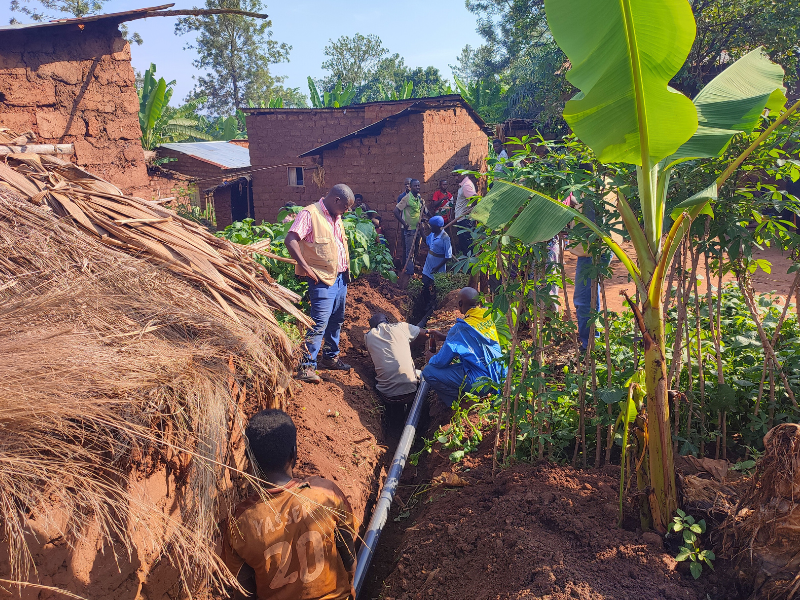
The second part, which sees me monitoring the new routes, concerns the network’s expansion. We’re talking about 20-25 kilometers of new excavations, a huge distance that has been covered thanks to the tireless work of the local population.
The meticulous manual work inside the tanks
Physically entering an empty cistern was a thrill. Inside, the men remove several centimeters of old plaster, having to dig it up to five centimeters deep, and they do it all by hand, for hours on end.
While outside, the women are busy sifting local sand which, mixed with cement, becomes the new waterproof covering that protects the tanks from the inside to prevent water leaks.
A community on the move in the hills of Burundi
During my field tour, I witnessed the enormous commitment of these people. The transport of pipes is a prime example.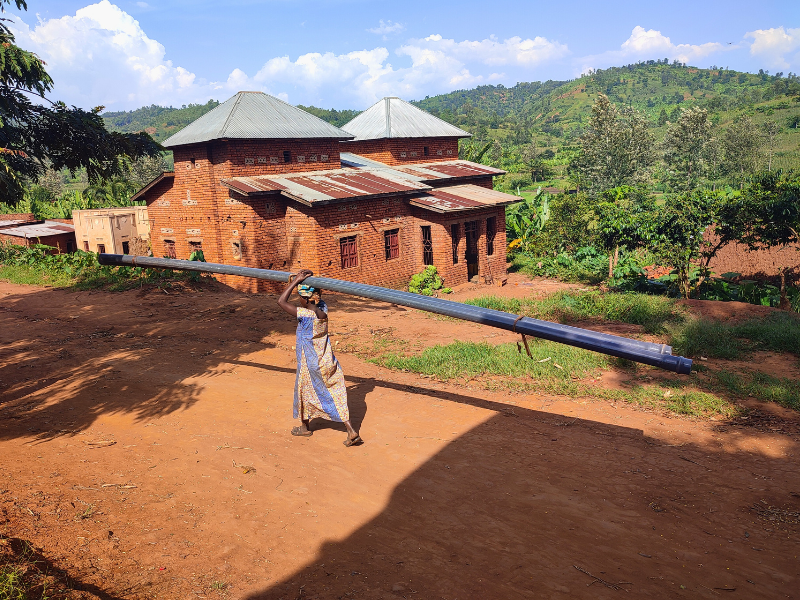 Since trucks can only reach so far, the pipes are loaded head-on or shoulder-first , one by one, right up to the tops of the most inaccessible hills. Men and women, regularly paid as laborers, actively participate in this construction site.
When I arrived at the restored drinking fountains, it was one of the happiest moments: the children took advantage of our presence to wash their hair and play with the water, something they are usually not allowed to do.
But they were really happy to see that flow again.
The diplomatic challenge in the municipalities of Mugina and Rugombo
Unlike past projects, this aqueduct crosses two municipalities: Mugina and Rugombo. One of the biggest challenges is getting the administrations to communicate and reaching memoranda of understanding for future maintenance, to prevent the project from falling into disrepair due to a lack of agreements. But this too is a challenge we are facing and will overcome together with the communities.
The wait is full of hope
In areas where the water has not yet arrived, the wait is filled with a participation that I have rarely seen elsewhere. In these lands the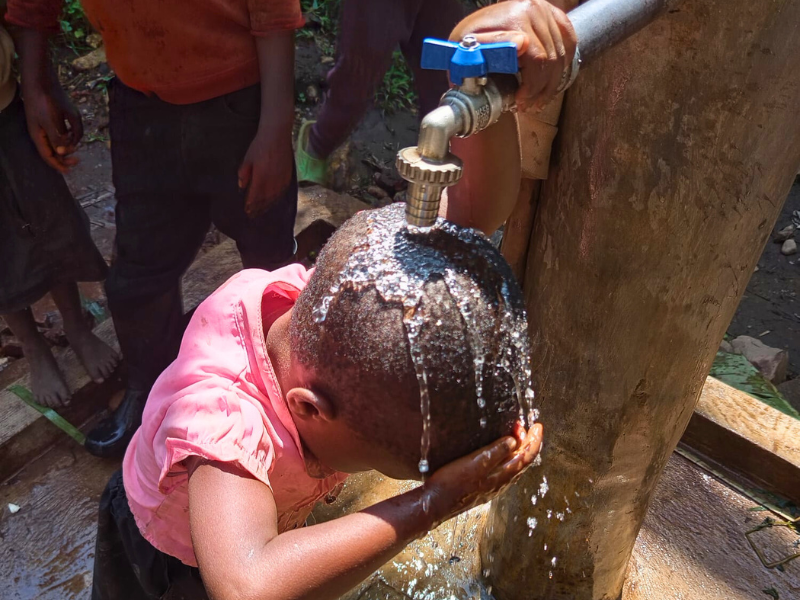 The cholera rate is still very high and the health problem is very serious: the arrival of drinking water is a common desire because they know how much it will change things.
People are incredulous but hopeful; they’re asking us to also run the tubes in neighboring communities, outside the initial study.
For now, we respond that we must stick to the established project, but with the promise to evaluate any possible future extensions if the resources are available. For all of them, the aqueduct in Burundi isn’t just a structural project; it’s the arrival of life.
(The “Water: Source of Life and Development” project is implemented by AMU in close collaboration with its local partner CASOBU , with the fundamental support of the CEI – Italian Episcopal Conference)
Emanuela Castellano, AMU project manager in Burundi